Most of the JET catalogue is built around getting players the most guitar for the…
What Is a Baritone Guitar? Everything You Need to Know
A baritone guitar sits somewhere between a standard electric and a bass. It’s still a six-string guitar you play like any other, but it goes lower, sounds bigger and opens up sounds a standard guitar can’t reach. If you’ve ever tuned down and found your strings going floppy, or wanted a darker, heavier voice for writing, a baritone might be exactly what you’re missing. Here’s how they work and who they’re for.
What makes a guitar a baritone?
The short answer is scale length. That’s the distance from the nut to the bridge saddles, or put simply, the length of string that vibrates when you play.
A standard electric guitar usually has a scale length between 24.75″ and 25.5″. A baritone stretches that to around 27″ or more. The longer scale lets the strings be tuned much lower while keeping enough tension to stay tight, clear and in tune.
Baritones also use heavier strings than a standard guitar, so the low notes have weight and definition rather than a loose, flappy feel.
How is a baritone guitar tuned?
The most common baritone tuning is B to B: B E A D F# B, low to high. That’s exactly a fourth lower than standard tuning (E A D G B E). Because every string drops by the same amount, all the chord shapes and scales you already know still work. They just sound lower.
Some players tune a baritone to A (a fifth below standard) for an even deeper sound, or to C for something a little brighter. Drop tunings such as drop A work well too, and are popular with heavier players.
Baritone vs. tuning down a standard guitar
You can tune a standard 25.5″ guitar down to B, but there’s a catch. At that pitch, the strings lose tension. They feel slack, buzz more easily, go sharp when you dig in and can sound muddy. You can fit much heavier strings to help, but you’ll usually need to adjust the setup, and the nut slots may need widening as well.
A baritone is designed for low tunings from the start. The longer scale keeps the tension where it should be, so low notes stay focused and tuning stays stable, even when you play hard.
Baritone vs. 7-string vs. bass
- Baritone: six strings, tuned lower across the board. Familiar shapes and a deeper overall voice.
- 7-string: a standard-tuned guitar plus an extra low string (usually B). It gives extra range at the bottom without changing the rest of the neck, but there’s a new string to learn.
- Bass: four (or more) strings, tuned an octave below a standard guitar. It’s a different instrument with a different role in a band.
A baritone gives you much of the low-end weight of a 7-string while still feeling and playing like a regular six-string.
What does a baritone guitar sound like, and who is it for?
A baritone has a thick, dark, slightly growly voice. It doesn’t sound like a bass. It’s still clearly a guitar, just with more depth and power. That makes it more versatile than many players expect:
- Rock and metal: lower tunings with tight, defined riffs that don’t lose clarity under gain.
- Surf, twang and “spaghetti western”: the classic clean baritone sound, with deep, reverb-soaked melodies.
- Ambient and soundscapes: rich chords and swells that fill a lot of space.
- Songwriting: a new voice for familiar shapes, which often leads to new ideas.
- Recording: doubling a standard guitar part with a baritone adds width and weight to a mix.
- Singer-songwriters: an easy way to play songs in a lower key without learning new shapes.
Is a baritone hard to play?
Not really. The longer scale means the frets are slightly further apart, so wide stretches take a little getting used to, and the heavier strings ask a bit more of your fretting hand. Most players settle in within a few sessions. If you already play a standard electric, you’ll feel at home almost straight away.
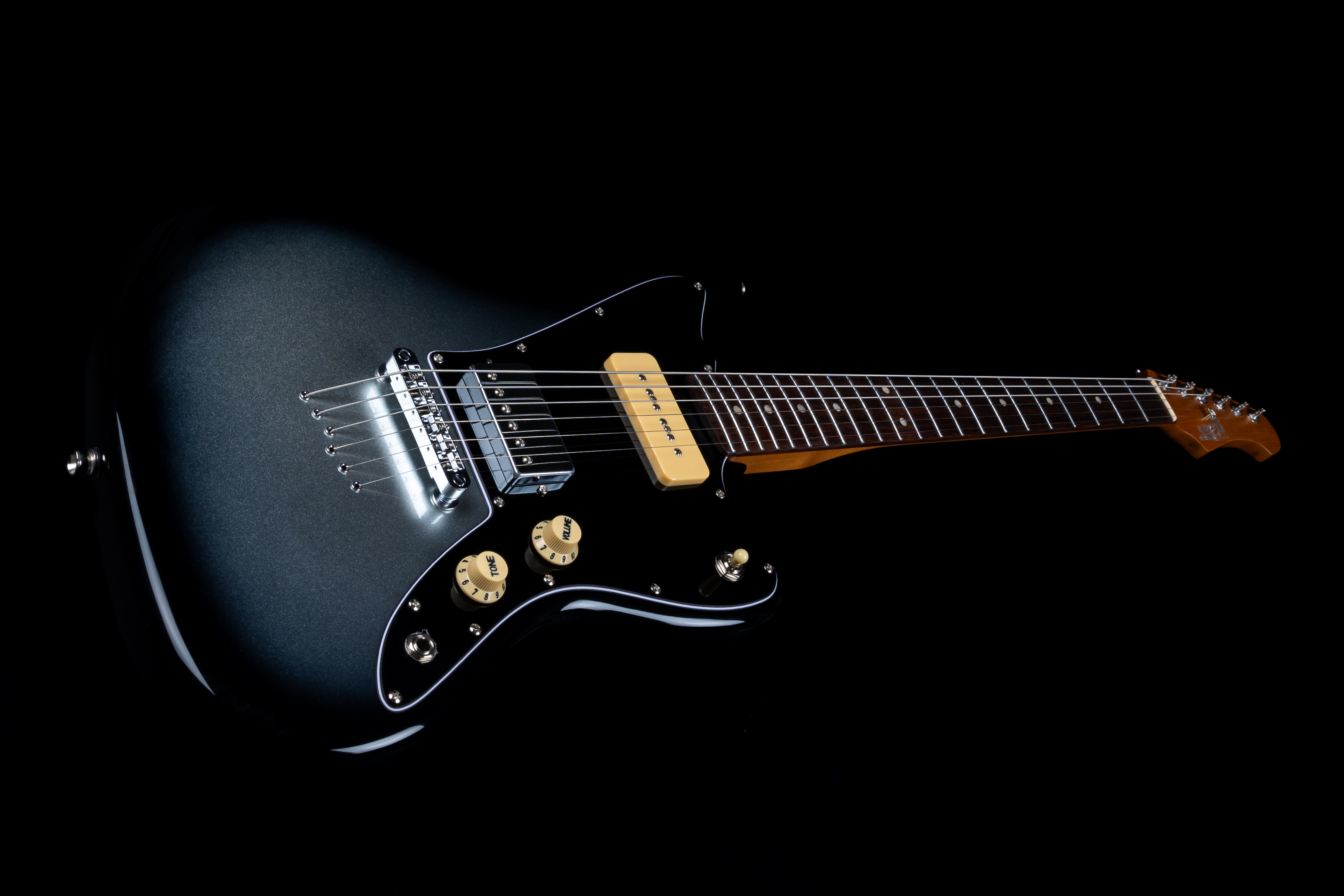
Meet the JET JJ-350 Baritone
RRP €415
The JJ-350 Baritone brings everything above together in a guitar that’s built to be played hard. It uses the same roasted platform found across the JET range:
- 27″ scale with 22 frets, built for low tunings
- Roasted poplar body and Canadian roasted maple neck for a stable, resonant build (find out why in Why Roasted Maple Necks Matter)
- Rosewood fingerboard with a 9.5″ radius and a comfortable Modern C neck profile
- Humbucker in the bridge, P90 in the neck: punch and clarity for riffs, with a warmer, rounder voice for cleaner parts
- Fixed bridge for solid tuning stability at low pitch
- Simple controls: one volume, one tone and a 3-way switch
- Two finishes: Moonburst and Charcoal
Whether you want heavy riffs, twangy clean melodies or just a new sound to write with, the JJ-350 Baritone is an affordable way to find out what a baritone can do.
Baritone guitar FAQs
Can I use regular guitar strings on a baritone?
Not really. A baritone needs heavier, longer strings to reach low tunings with the right tension. Look for sets labelled “baritone.”
Can I tune a baritone to standard E?
Not safely. The long scale would put far too much tension on the strings and neck. Baritones are designed to sit lower.
Is a baritone good for beginners?
It can be, especially for someone drawn to heavier music or lower keys. Most beginners start on a standard guitar like the JS-300, but there’s no wrong first step.
Do I need a special amp?
No. A baritone works with any guitar amp and pedals. Some players roll back a little bass on the amp to keep things tight.
Ready to go low? Check out the JET JJ-350 Baritone →
Related Posts